

CHEAT SHEET: CREATINE. Every Woman's Essential Reference Guide After 50
Why you need it. PLUS 10 powerful ways to use it for longevity, strength, bones, sleep issues, better thinking, and more.

“For decades, creatine has been misunderstood as something only bodybuilders or elite male athletes use. That misconception has kept many women from one of the most well-researched, effective, and female-relevant supplements available.”
— Dr Stacy Sims
WHAT’S INSIDE:
Creatine myths — busted
Explainer: A Creatine 101
Why creatine matters for women over 50
Your creatine quick-start guide
10 powerful ways to use creatine for healthy ageing and more
PDF download: The Creatine Cheat Sheet
There’s a lot of hype out there
In my decades in food media, I saw hundreds of crazy trends come and go — hello, activated Almonds and celery juice fasting.
Watching them fade as fast as they exploded was always so satisfying.
BUT
Let’s be clear. Creatine is not in that camp. It’s not a gimmick. You only need to look at the leading clinical research. If anything, there’s more promise in creatine for women over 50 than it’s given credit for.
That’s why I’ve been looking forward to creating this Creatine Cheat Sheet as part of our Road to Stronger series. And, not just to support your strength — though it’s sure to do that.
Creatine has so many unique bonuses that really matter to all women. In fact, once you bust through myths around creatine, perhaps the only question we’re left with is this:
“Where have you been all my life?”
Here’s your easy roadmap. And so you can make the most of it, I’ve included a PDF download at the end of the article.
Let’s go 🚗💨


PS If you enjoy this article, please tap the ❤️ and share. It really helps to support my work… and spreads the good word about creatine to women.
Creatine: Myth vs Fact
First, let’s blow off the myths that science has long torn down.
The Myth: Creatine is a men’s supplement
The Reality:
Creatine is naturally found in human cells — in both men and women. And, if anything, creatine offers more and greater benefits for women than men, especially after 50 when our natural hormone protection declines.
The Myth: Creatine makes you bloated.
The Reality:
According to Dr Stacy Sims, “creatine bloat” is a product of old-school bodybuilding protocols, rather than the supplement itself. It stemmed from male bodybuilders combining large doses of around 20 grams daily, with a high-carb diet, forcing the body to retain fluid. This is not an issue for women who take the smaller standard, health-focused doses we’ll be discussing.
The Myth: Creatine makes women bulky and causes weight gain.
The Reality:
Women simply do not have the baseline testosterone levels required to accidentally “bulk up” from creatine. Will the scale tick up by a pound or two when you start? It might. But creatine cannot make you gain fat. Rather, creatine pulls fluid directly inside the muscle cell (not under your skin). This cellular hydration makes your muscles look leaner, tighter, and more toned.
The Myth: Creatine is for athletes and bodybuilders
The Reality:
It’s true that creatine is best known for its remarkable impact on muscle and physical performance. But, as you’ll soon see, the benefits are far more broad-ranging — creatine is even being seen by many experts as a healthy longevity essential for women navigating midlife and beyond.
Before we dive into why creatine matters for women and the many ways to use it, here’s a quick primer of need-to-know info — creatine, explained.
Explainer: Creatine 101
🧐 What is creatine?
Creatine is a natural compound — mainly found in our muscles and brain cells — that our body uses for energy.
🧐 How does creatine work?
Creatine acts like a backup battery that the body taps into during periods of high demand such as physical exertion or intense mental focus. Body cells also call on creatine when they are under-gunned or under a heavy load.
🧐 How much creatine does our body make?
Our liver, kidneys, and pancreas only produce about 1 to 2 grams a day. This is barely enough to replace what your body naturally breaks down and excretes daily.
🧐 Can we get creatine from food?
While you can top up your levels with red meat and fish, dietary sources only provide a few grams at most. You would have to eat a massive amount of steak daily to get the clinical benefits.
🧐 Is creatine safe?
Yes. In fact, creatine is one of the most thoroughly researched dietary supplements on the planet. Decades of clinical tracking spanning well over 1,000 human studies have consistently proven its safety profile. That said, as always, check with your doctor before starting in case you have a pre-existing condition that may be impacted.
Why Creatine Matters Most for Women
From a pure biological point of view, women are on the back foot in terms of their natural stores of creatine.
Women store 70–80% less creatine than men. This is a direct result of having less muscle mass — a creatine supplement can elevate this by 20%.
Women typically consume less dietary creatine (it’s found mainly in red meat and seafood) — a creatine supplement helps correct the shortfall.
But, here’s the thing we’re not talking about enough.
Creatine supports women in many of the areas where they’re most vulnerable as they age. It enhances our strength, power, muscle mass, brain health and bone density, all the while also helping us navigate hormonal shifts, and even offset sleep loss.
We’ll be covering these below, along with how creatine can make a difference for each.
Your Quick-Start Guide
Let’s start with the basics.
🛒 What to buy
Look for Creatine Monohydrate on the label. That’s it. Ignore everything else — like “buffered” or “HCL” creatine. Creatine Monohydrate is the gold standard backed by the research.
⏱️ When to take it
Generally speaking, timing doesn’t matter. Mix it with your morning coffee, drop it in your afternoon tea, or shake it into your post-workout water. For exceptions with special timings, see 10 Powerful Ways to Use Creatine, below.
☕ How to take it
It is completely tasteless, so you can add it to whatever you like: tea, coffee, smoothies, water — any liquid. Just drink soon after mixing
✏️The Golden Rule
Avoid skipping days. For best results, consistency is key. If you miss a day, don’t panic and don’t double your dose the next day. Just get back on track
10 Powerful Ways to Use Creatine
Here’s how to tap into the power of creatine and why it matters after 50.
One daily 3-5g dose is your starting point for overall health.
Or tailor the dose to what you want creatine to do for you, specifically.
💪 Strength
How it helps:
Supports the maintenance of lean muscle mass during hormonal shifts.
Why it matters for women after 50:
Women lose roughly 3% to 8% of their muscle mass each decade after 30, accelerating after menopause. This progressive muscle wasting is known as sarcopenia. By supporting muscle mass, creatine protects against falls, frailty and loss of independence.
The dose:
3-5g daily, as part of your single daily maintenance dose.
⚡ Energy
How it helps:
Optimises cellular energy production to reduce physical and mental fatigue.
Why it matters for women after 50:
As estrogen drops, our cellular power plants (the mitochondria) become less efficient at turning food into fuel — hence the daily exhaustion so many women over 50 face. Creatine offsets this process by effectively recharging cells.
The dose:
3-5g, as part of your single daily maintenance dose.
🏃♀️ Fitness
How it helps:
Improves stamina during exercise and supports muscle recovery between workouts.
Why it matters for women after 50:
Beyond charging up cells for higher general performance, creatine also helps post-workout. With hormonal shifts, the body takes longer to repair muscle fibres. This can leave you sorer for longer after a workout or gardening session. Creatine speeds up recovery.
The dose:
3-5g, as part of your single maintenance dose.
😴 Sleep Support
How it helps:
May improve cognitive function during periods of sleep disruption.
Why it matters for women after 50:
Poor sleep can become a way of life during the menopause years, and often later as well. While creatine is not a sleep aid as such, it acts as a buffer when you’re sleep deprived, keeping your brain sharper even after a bad night.
The dose: 3-5g, as part of your single daily maintenance dose.
🛡️Gut Lining Protection
How it helps:
Provides energy to intestinal cells, which may help protect the mucous membrane.
Why it matters for women after 50:
Midlife hormonal changes weaken your intestinal lining, making the digestive tract prone to systemic inflammation. By boosting gut cell regeneration, creatine may help protect against conditions such as chronic bloating and irritable bowel syndrome (IBS).
The dose:
3–5g, as part of your single daily maintenance dose.
🦴 Bone health
How it helps:
Strengthens the skeletal frame and supports long-term bone mineral density.
Why it matters for women after 50:
Women can lose up to 10% to 20% of their total bone density in the first five years following menopause, increasing osteoporosis risk. Studies show creatine, when paired with resistance training, stimulates bone-forming cells and slows down bone thinning.
The dose:
3-5g, as part of your single daily maintenance dose.
🧠 Brain Power
How it helps:
Fuels the brain — which consumes a massive 20% of the body’s daily energy —to improve focus and short-term memory.
Why it matters for women after 50:
During menopause, as estrogen levels drop, the brain's energy stalls – often leading to “brain fog.” Creatine offsets this by keeping brain cells powered. Researchers are also looking at creatine for dementia prevention — which disproportionately affects women globally.
The dose:
For ongoing advanced cognitive support: 5–10g daily.
NOTES:
Build up to 10g slowly, over a few weeks.
This replaces 3-5g daily maintenance dose.
CREATINE TO THE RESCUE
Keep these special one-off uses for creatine handy.
✈️ Jet Lag & Sleep Deprivation
The problem:
Travelling across multiple time zones or one-off shift work severely compromises energy stores.
How creatine helps:
It acts as a battery pack for the body and brain, supporting your energy after a long flight or shift work disruptions.
When to take it:
One day only on EITHER the day of travel or immediately after arrival, in place of your usual maintenance dose.
The dose:
0.3g per kilo of body weight divided into four doses across one day (morning, midday, afternoon and evening). Here’s a handy ready reckoner.
Jet Lag & Sleep Deprivation: Creatine Dosage Chart
This protocol is for a single day with four doses.
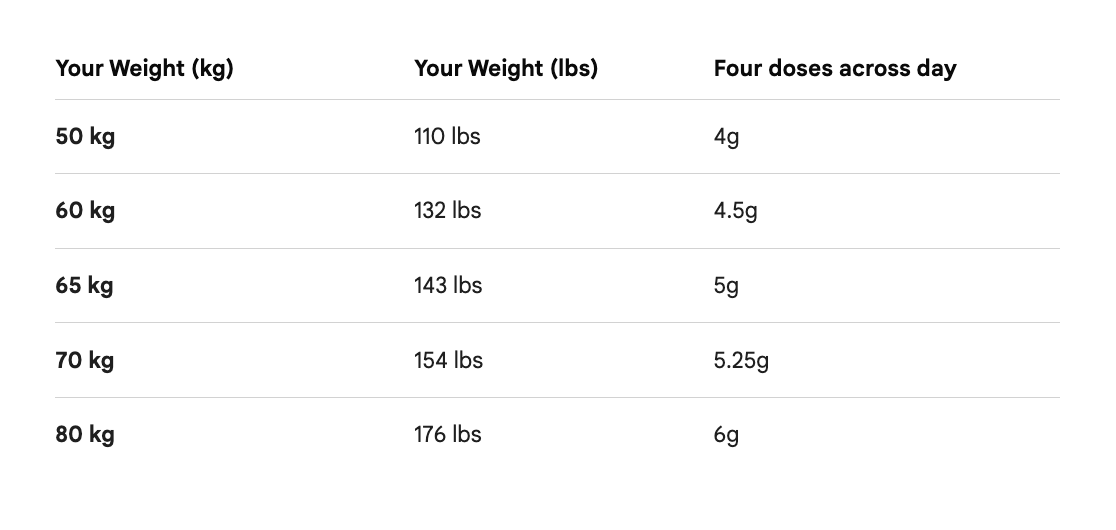
To avoid gastrointestinal discomfort, including bloating, and stomach cramps, follow the higher daily dose protocol only if you’ve been taking creatine daily and consistently for at least a few weeks.
🥱 The “No Sleep” Emergency
The problem:
You are running on empty after tossing, turning, and getting zero rest all night.
How creatine helps:
It acts as an immediate neural buffer, supporting energy levels in your brain to help clear morning mental fog and maintain focus when sleep-deprived.
When to take it:
A one-off strategy the morning after a terrible night of sleep.
The dose:
A one-off intake of 10g spread across the morning, NOT taken all at once, to support sustained energy.
🏋️♀️ Heavy Strength-Training Days
The opportunity:
Maximising your recovery window and amplifying your hard work after an intense lifting session.
How creatine helps:
Floods muscle cells with immediate energy while lowering post-exercise inflammation.
When to take it:
Right after your workout.
The dose:
5g to 10g right after your workout, alongside your protein shake or meal.
🕒 When will I see results?
Experts suggest it takes 3 to 4 weeks of consistent, 3–5g daily intake for the body’s creatine stores to reach what’s called “full saturation.” This is when your cellular storage tanks for creatine are 100% full, at which time you can expect to see the positive effects of creatine kick in.
A final note
Creatine is one of the truly great stories in the science of ageing. With ongoing clinical trials, we’re constantly discovering new benefits of this transformative compound.
As sports scientists, neuroscientists, psychiatrists, and gerontologists expand our knowledge of creatine as a countermeasure against ageing and brain disease, who knows what’s around the corner?
Whatever happens, we’ll be sure to cover it here on this Road Trip to Younger. Stay tuned.
PDF DOWNLOAD: YOUR CREATINE CHEAT SHEET

What’s next?
The Road to Stronger series continues. This is every woman’s guide — from first-time lifter to seasoned trainer. Whether you’re at home, at the gym, or somewhere in between, each program is designed to be effective, efficient, and truly enjoyable.
The Road to Stronger workout series has everything you need to get started with confidence and keep going with consistency — training cards, trackers, and videos.
Road Trip to Younger magazine is ad-free
and reader-supported.
Thank you for helping to support my continuing work here 🙏🏼
Brodee xox
If you enjoyed this article, please hit the like button and share this post.
and
If you know someone who would value this content:
Further reading and references
Want more?


From the Longevity News Desk
Our ongoing series shines a spotlight on studies that matter for women 50+.



REFERENCES
Creatine in women’s health: bridging the gap from menstruation through pregnancy to menopause
Journal of the International Society of Sports Nutrition. 2025 Dec;22(1):2502094.
Abbie E Smith-Ryan, et al.
This was the journal’s most-read paper last year.
“Heads Up” for Creatine Supplementation and its Potential Applications for Brain Health and Function
Sports Medicine, 2023 Dec;53(12):2443–2465
D. G. Candow, et al.
Creatine Supplementation and Ageing Musculoskeletal Health.
Nutrients, 2019 Apr;11(4):877.
D. G. Candow, et al.
This information is for general knowledge and should not be taken as medical advice. Always consult with a healthcare professional before starting any new supplement regimen.
Once again. Great info
Brilliantly explained, thank you.